How Do You Know if a Stud Has Snapped From a Missing Lug Nut
Past Matt Weber
A car or truck'due south lug nuts and studs are the crucial components that hold the wheels onto the vehicle. If they fail while driving, then ane would expect bad things to happen, ranging from sudden immobilization to a complete loss of command that results in a raging inferno of twisted metallic.
Although it's highly unlikely that all of a bike'southward lugs will neglect at once, it's always a expert idea to keep your wheels mounted securely to the vehicle with all appropriate fasteners, and broken lug studs are a common trouble. If left unrepaired, the improper connection of the cycle can result in unwanted vibration while driving that could affect steering and pb to premature wear in other vehicle components.
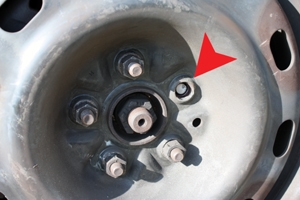
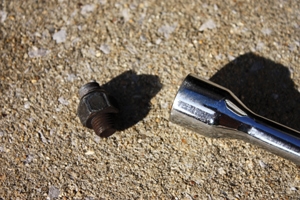
The EHT staff recently bankrupt a lug bolt during a routine tire-rotation job. We suspect the nut and bolt had been cross-threaded past a devil-may-care mechanic, because the commodities easily twisted in half when using a lug wrench without exerting any extra torque. Hither's a pace-past-stride account of how to replace a broken lug nut stud (as well called a lug bolt or wheel stud).
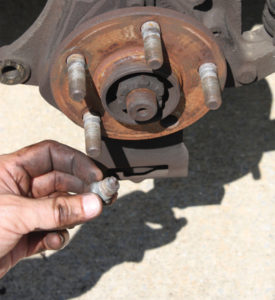
Remove and Replace Lug Bolts / Wheel Studs
Use a wrench to loosen the wheel's lug bolts while the vehicle remains on the footing. So jack up the vehicle and support information technology with jack stands. Remove the lug nuts and pull off the tire.
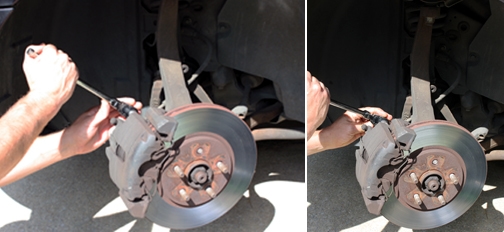
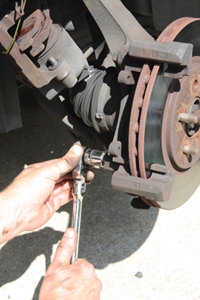
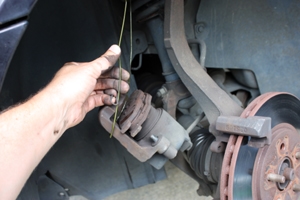
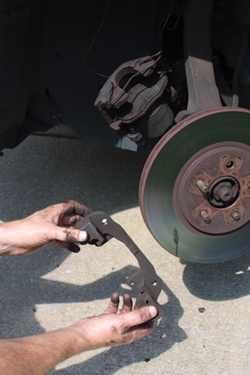
Side by side, use a socket wrench to remove the brake caliper. Annotation, the driver bits required to remove the caliper pins vary amongst manufacturers—some crave hex $.25, some require star-drive bits, etc. With the caliper off the car, use a wire to hang the caliper from the vehicle to keep the weight off the brake line. Then, remove the caliper's mounting bracket. (If working on a drum-style brake organisation, remove the brake drum.)
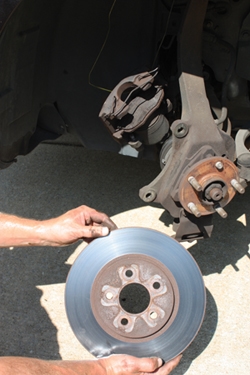
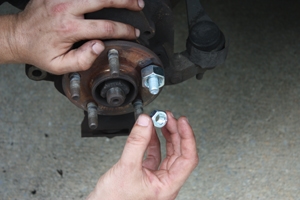
Remove the rotor and set bated in a place where it will not exist scratched or exposed to dirt or oil. Use a metallic hammer to knock the broken lug commodities out the back of the wheel. Aim advisedly and be certain not to damage the threads of the adjacent lug bolts. Use your fingers to pull the broken commodities from the rear of the hub flange.
Install New Lug Bolt
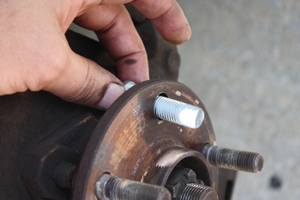
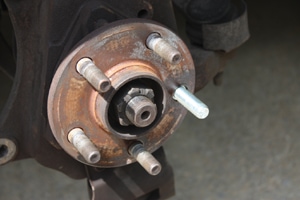
The replacement bolt was a stock part from a local automobile parts supplier. To install the new bolt into the bolt hole, the wheel must be turned to marshal the hole with a slot on the rear of the hub flange, which provides the clearance to thread it through. If the hub flange must be turned for alignment, you may have to jack up the contrary cycle then the axle tin can freely spin to match the hole with the slot.
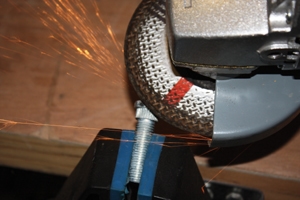
One unexpected problem with this job was the full, round head of the replacement bolt. You'll see the in the photos that the head of the original bolt was apartment on one side because it is positioned then close to the axle housing. The full caput of the replacement obstructed the bolt's insertion into the lug hole, so I had to clamp the bolt in a vise and flatten 1 side of the caput with a iv-in. electric grinder.
For easier installation, shop the replacement bolt in a freezer for a few hours. The tolerance of the lug bolt and the hole will be very tight, and any small corporeality of contraction the cold temperature may cause in the metal alloy will get in easier to install the new bolt. This will assistance profoundly with your wheel stud replacement.
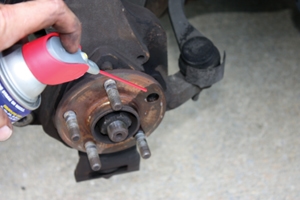
Use a metallic-bristle castor to knock away any rust from the wheel and lubricate both the bolt and the bolt hole with a spray-on solvent. Insert the bolt straight into the hole as far every bit it will become (the bolt will stop at its shoulder at this point).
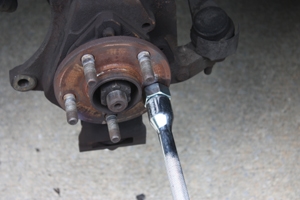
Thread a very large nut over the end of the new commodities (a stack of large washers volition also work). The large nut is not intended to thread onto the bolt. There should be no positive connection betwixt the bolt and large nut; it should slide loosely over the bolt like a washer to function as a spacer.
Side by side, thread the new lug nut over the end of the new bolt, sandwiching the big nut between information technology and the hub flange. Apply a lug wrench to tighten the nut, which will depict the bolt into the hub until the commodities head is flush with the dorsum of the flange and snugly installed. Remove the large nut, tighten the lug nut, and the job is done. Clean the rotor with brake dust remover. Contrary the procedure to supersede the brake, cycle and tire, tightening the lug basics to the manufacturer'southward specifications.


Other Automotive Related Articles
- Installing a Winch
- Power Pace for a PickUp Truck
- Repairing your Flat Tire
- How to Utilize a Coil-on Truck Bed
Source: https://extremehowto.com/replace-broken-lug-nut-stud/
0 Response to "How Do You Know if a Stud Has Snapped From a Missing Lug Nut"
Post a Comment